Portfolio
.svg)

How I Work
About Me

Disctrade is a personal project of mine that intends to provide a platform dedicated to the disc golf second-hand market. It is still a work in progress but it will hopefully be developed and launched in the future.
Disc golf is growing at an incredible pace and the sport is being played more than ever before. This has created a demand on discs that is too high for manufacturers to keep up.
Disc golfers are struggling to get ahold of certain discs, especially ones that fit their preferences. More and more disc golfers are joining spread out online communities to find discs and other gear, however, there isn’t a dedicated platform that cater to this experience.
The data below is based on surveys and interviews conducted by me in combination with data from Udisc and PDGA. The pool of participants are mainly swedish and american disc golfers that are active within different disc golf communities.
Plays multiple times a week
Plays at least once a week
Plays 1-2 times every month
Plays a few times every year
of respondents own over 30 discs
of respondents use less than 30 discs
of respondents buy second-hand discs
of respondents sell discs
Average yearly spendings on new disc golf gear by hard core disc golfers
Average yearly spendings on second-hand
disc golf gear by hard core disc golfers
Average yearly spendings on new disc golf gear by dedicated core disc golfers
Average yearly spendings on second-hand
disc golf gear by dedicated disc golfers

"
It's cheaper
"
I want to save some money
"
Better price

"
Some discs are easier to find
"
The supply is much greater
"
Higher availability

"
To get desirable discs
"
I like to buy beaten in discs
"
Only way I can find some discs
"
It's cheaper
"
I want to save some money
"
Better price
"
Some discs are easier to find
"
The supply is much greater
"
Higher availability
"
To get desirable discs
"
I like to buy beaten in discs
"
Only way I can find some discs

"
Earn back money I spent
"
Money to buy another disc
"
To make some money

"
No longer need the disc
"
Get rid of discs I don't use
"
Don't really like it anymore
"
Earn back money I spent
"
Money to buy another disc
"
To make some money
"
No longer need the disc
"
Get rid of discs I don't use
"
Don't really like it anymore
"
Earn back money I spent
"
Money to buy another disc
"
To make some money
of respondents prefer specific brands
of respondents prefer specific disc molds
of respondents prefer certain colors and prints
How might we solve the problem with lack of supply on the disc golf market and satisfy the needs of its consumers?
A platform dedicated to buyers and sellers of disc golf gear. Disctrade brings the entire second-hand market into one platform and makes more discs more available to more disc golfers.
The idea of a dedicated platform to the second-hand market began to form when I started dying my own discs and considering selling a few. Additionally, the massive growth of the sport in recent times contributed to discs running out of stock very quickly and the second-hand market was the only place you could find some discs.
I explored my options and was left with a few different platforms but Facebook seemes like go-to place. I quickly experienced many of the downsides with such a generic platform and couldn't help but imagine a platform dedicated to buyers and sellers of disc golf gear.
First and foremost, I needed to validate or invalidate my initial hypothesis. Was I really the only one experiencing problems or having unmet needs when looking to buy or sell disc golf gear?
I started by collecting quantitative data through a survey targeted towards people within these different communities. It focused on consumer behaviour and the experience of buying and selling disc golf gear. I also did some interviews with people within the target group to gather qualitative data. After analyzing the data, I gathered a few insights.

Disc golfers are spending a lot of money on the second-hand disc golf market.
A large majority of disc golfers buy and own a lot more discs than they use.
The main reasons that detract disc golfers from buying second-hand disc golf gear is related to the ease of buying new gear, trust issue and not knowing where to buy.
The main motivations for buying second-hand disc golf gear is related to lack of supply on the primary market, lower costs or disc characteristics that are unique to used discs.
The main reasons that detract disc golfers from selling second-hand disc golf gear is related to a percieved complex process and not knowing where to sell.
The main motivations for selling second-hand disc golf gear is to get rid of unused discs in order to make some money.
A majority of disc golfers have multiple preferences when it comes to what discs they buy.
These insights combined with reserach I did on platforms dedicated to other types of second-hand marketplaces gave me enough confidence to move forward. I knew there was a great deal of potential to create a much better experience for both buyers and sellers of disc golf gear.
When I had a good understanding of the motivations, needs and problems of the target group, I started to formulate different problem statements. See the main one above.
By this point, I started considering this project as a possible business. Therefore, I began to define business goals as well as specifying the target group.
I reviewed my defined problem statements and business goals and considered any ethical conflicts. This lead me to focus a lot on how Disctrade could contribute positively to environmental issues.
By this point, I had been able to validate or invalidate a bunch of hypotheses regarding general consumer behaviour and motivations within the disc golf second-hand market. This allowed me to formulate a number of problem statements that I now needed to solve. In order to do that, I created numerous hypothesis that assumes what should be in the app or not andy why, all based on the problem statements.

Disc golfers would be more willing to buy second-hand disc golf gear if the process was more similar to how they normally buy things online.
Disc golfers would be more willing to buy gear from someone with positive reviews from others.
Disc golfers would be more willing to buy second-hand disc golf gear if they have the opportunity to easily find gear that fit their preferences.
Disc golfers would be more willing to buy second-hand disc golf gear if they are better informed about the listed items.
Disc golfers would be more willing to buy gear on a platform dedicated to the disc golf second-hand market rather than on Facebook.
Disc golfers would be more willing to sell second-hand disc golf gear if the process of creating a listing is percieved as easy.
Disc golfers would be more willing to sell second-hand disc golf gear if shipping and payment options are suggested.
Disc golfers would be more willing to sell second-hand disc golf gear if they saw someone searching for gear they own.
Disc golfers would be more willing to sell gear on a platform dedicated to the disc golf second-hand market rather than on Facebook.
Based on the hypotheses above and the observations I'd done on other marketplace platforms, I started to write down a bunch of ideas for features within the app. The intention was to then test these features with potential users in order to validate or invalidate my hypotheses and thereafter iterate on the design. With a high level of ambition and not a lot of resources, I knew I that many of the features would be difficult to implement in the early stages of development. To figure out what would be realistic in the MVP-version, I evaluated every feature based on technical and logistical feasability in combination with user and business value.
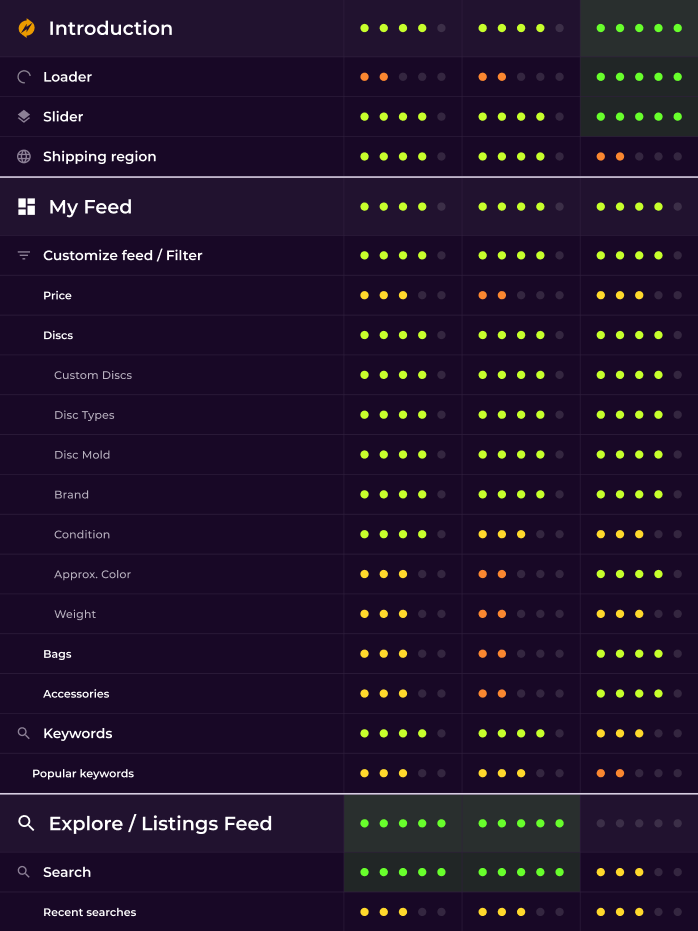
This is about 10% of the list.
Based on the lists of features, I started to create some simple wireframes and and visualized user flows, information structure and navigation. This was of course something I would come back to and iterate on as with everything else.

With the base structure in place, I was ready to design high-fidelity interfaces.
The first step was to make use of my self-made design system template. This is where I pre-define guidelines for things such as colors, typography, grid structure and minor components such as buttons.
Now it was time to grind. I designed two versions of the app, one with every single feature and another that was more realistic as an MVP. I rely heavily on Figma's auto-layout feature in combination with the component library to keep the design dynamic, reusable and easy to implement in the future. See the main features explained below.

Through a customizable feed, a user would be able to add specific filters, keywords or even follow other sellers. This would allow disc golfers to have easy access to discs that fit their prefences.
.svg)
By bringing the entire second-hand disc golf market to one platform the available disc supply could increase. Listings would also be easier to find through search and filter options.

To enable a safe experience where buyers and sellers can trust each other - a user review system would be implemented in combination with personal account identification and safe payment methods.

The process of creating and managing listings has been optimized for disc golfers. It's intuitive and also enables sellers to create more lucrative listings.
interactive high-fidelity experience so that my hypotheses could be tested in a realistic environment. I chose to work with ProtoPie as it's one of the industry leading tools when it comes to creating complex interactions in your prototype. ProtoPie also has a plug-in for Figma which allows easy exports of your design.

Based on my hypotheses, I designed a user test that included realistic scenarios that prompted the user to interact with the prototypes main features. The test users were also informed to share their thoughts out loud to the best of their ability. To make sure I gained as much information as possible, I formulated questions to ask before, during and after the test as well. This would allow me to have a better chance to validate or invalidate my hypotheses.
This is where I currently stand in the design process. Up to this point, I have conducted 4 user tests, however, I'm looking to do at least 4 more to gain a diverse set of perspectives.
The plan is then to analyze the data, formulate new insights, iterate on the design and hopefully manage to launch it in the future.

+46 76 133 28 78

henningbergner@gmail.com

Stockholm, Sweden
.svg)
