.svg)

.svg)
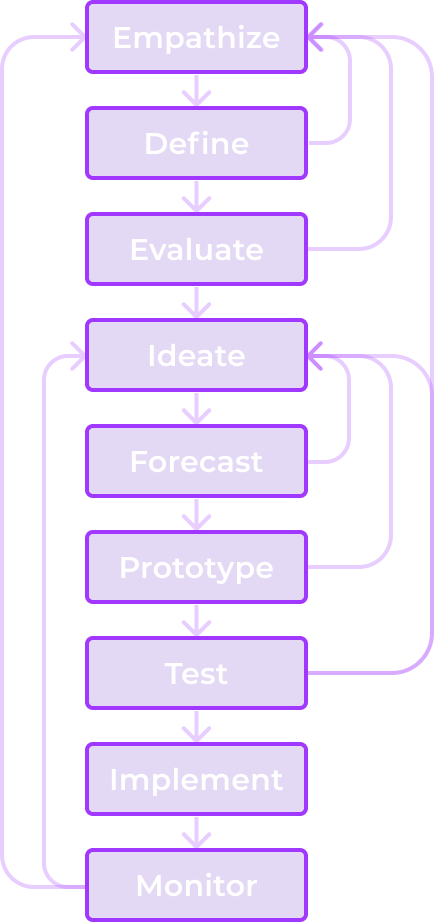

The first step is always to empathize with users in order to understand their motivations, needs and problems. This is essential when designing something useful. With that said, understanding business goals and technical constrains is just as important to create a successful product or service.

Formulating Hypotheses & Validation Condition

Deciding Research Methods & Questions

Qualitative Data Gathering

Quantitative Data Gathering

Data Analysis
After gathering insights from analyzing the gethered data, the next step is to define one or multiple problems to solve. This is also a good time to define things such as goals and expectations to align everyone involved in the project.

Formulating Problem Statement

Alignment Workshop
In order to remain ethical, it’s important to evaluate the defined problems and goals through different perspectives. Why do we need to solve this problem? Who is it really benefiting?

Evaluation Workshop
At this stage, it’s time to start exploring possible solutions to the problems through ideation. It’s important to welcome multiple participants and norm-breaking ideas. Problem-solve with the user's best interest in mind.

Ideation Workshop

Sketching
After coming up with a concept, consider the future impact of the solution. What could happen as it is used over time? What could happen if it becomes very successful? Who would be able to use it? Could it be used to do harm?

Forecast Workshop
Now it’s time to create a prototype version of the generated concept idea. This can be done in different ways and fidelities depending on what stage the project is in, however, it should always be based on testable hypothesis.
Formulating Hypotheses & Validation Condition

Lo-Fi Prototype Design

Hi-Fi Prototype Design
When the prototype is ready, begin to design the specifics of the test or tests with the intent to disprove the pre-defined hypotheses. Conduct the test or tests, observe, analyze, learn and gain insights to use for design improvements.

User Experience Testing

Usability Testing

Data Analysis
After sufficient testing, it’s time for implementation. This initially means implementing all project learnings so far into a design. After the design is tested and validated, it can be implemented from a developement perspective. It’s essential to maintain good design documentation that is based on the development process to facilitate a smooth transition between design and finished product.

Information Structure & User Flow Design

User Interface Design

Interaction Design
Design System Design
Content Design
Closely follow the progression of the product or service and the users. Is it impacting individuals or society negatively over time? Are there any changes that could make it more ethical in some ways?
Ethical Thinking
Data Analysis

+46 76 133 28 78

henningbergner@gmail.com

Stockholm, Sweden

.svg)
